The Margin Multiplier: How Autonomous Sales Infrastructure Resets the Unit Economics of the Modern Moving Fleet
Discover why decoupling sales from human labor is the only way to achieve 30%+ net margins in the 2026 moving market.
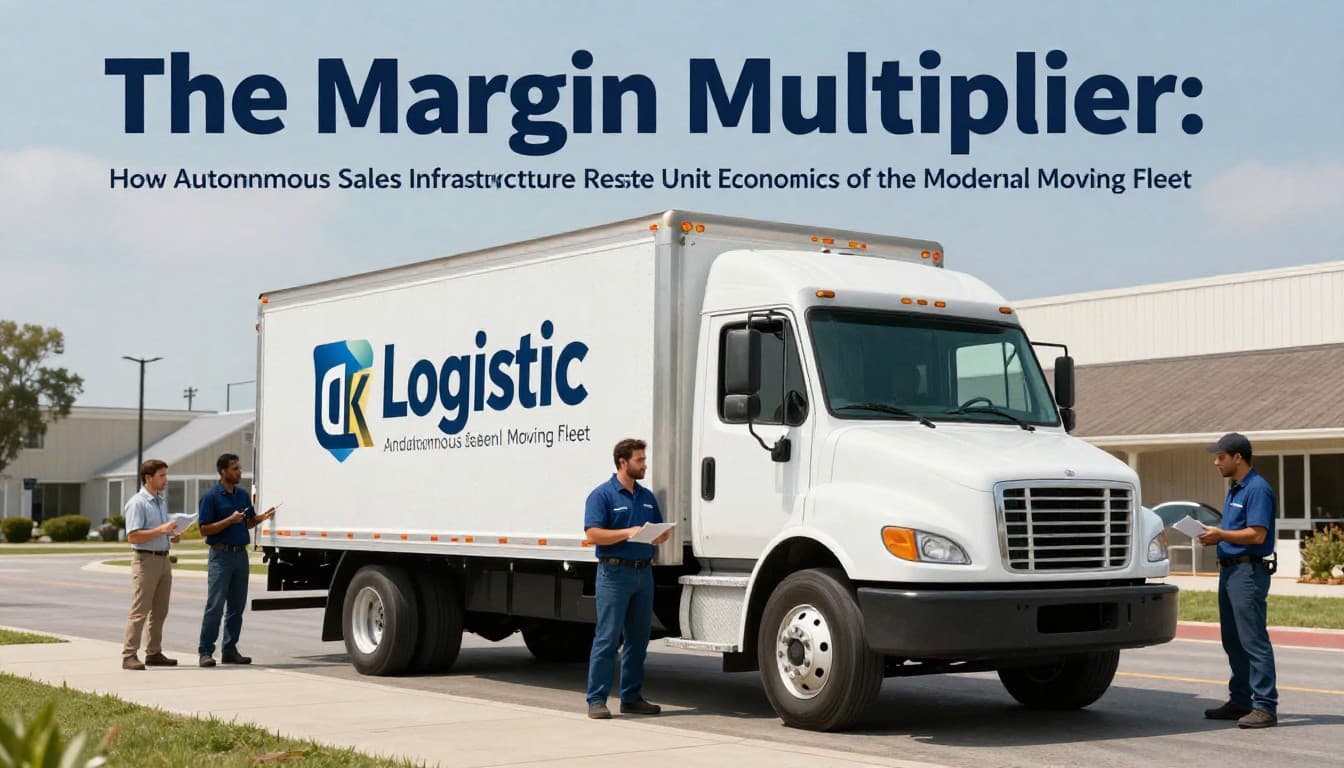
In the landscape of 2026, the moving industry has reached a critical inflection point. For decades, the growth of a moving enterprise was tethered to a linear relationship: to book more moves, you needed more sales representatives. To handle more inquiries, you needed more headsets. This model, while functional in a lower-cost era, has become the primary bottleneck for the modern fleet.
Today, the volatility of lead costs, combined with the rising expectations for instantaneous, 24/7 engagement, has rendered the traditional human-centric sales office a high-risk liability. We are witnessing a fundamental shift where the "Margin Multiplier" is no longer found in optimizing truck routes alone, but in the total reset of sales unit economics through autonomous infrastructure.
The Unit Economics Paradox of 2026
The fundamental challenge for any moving business owner in 2026 is the compression of net margins. While top-line revenue may grow, the "cost to acquire" and "cost to serve" have traditionally scaled at the same—or higher—rate.
When your sales engine relies on variable human labor, your margins are perpetually vulnerable to:
- Recruitment and Churn Cycles: The cost of replacing a seasoned estimator or sales rep in 2026 has tripled over the last five years.
- Inquiry Latency: As we explored in The Capture-First Strategy: Neutralizing Competitor Ad Spend by Eliminating Intake Latency in High-Volume Moving Markets, even a five-minute delay in responding to a lead in today's market results in a 60% drop in conversion probability.
- Operational Ceiling: Human teams have a physical limit. They sleep, they take breaks, and they struggle with the surge capacity required during peak seasons or month-end rushes.
The Margin Multiplier exists where these variables are neutralized. By transitioning to an autonomous sales infrastructure, we are not just "automating a task"; we are rebuilding the economic foundation of the moving enterprise.
Resetting the Customer Acquisition Cost (CAC)
In the traditional model, CAC is a combination of marketing spend and the labor cost of the sales team. In 2026, digital advertising platforms have become hyper-efficient, meaning your competitors are likely bidding on the same keywords and audiences. The differentiator is no longer who sees the lead first, but who secures the lead first.
Autonomous voice infrastructure operates at the "speed of trust." When a prospect clicks an ad at 9:00 PM on a Sunday, an autonomous agent engages them in a natural, high-fidelity voice conversation instantly. There is no "we will call you back Monday morning."
By eliminating the need for a standing army of after-hours or weekend staff, the labor component of CAC drops by as much as 80%. This capital can then be reinvested into higher-intent lead sources, creating a virtuous cycle of growth. Building on the concepts of The Capital Reallocation Blueprint: Driving 2026 Moving Growth by Transforming Variable Sales Labor into Fixed Autonomous Infrastructure, we see that the most successful fleets are those that treat their sales engine as a fixed-cost asset rather than a variable-cost burden.
The Throughput Advantage: Maximizing Fleet Utilization
A moving truck sitting idle is a depreciating asset. To maximize the ROI of a physical fleet, the sales engine must provide a consistent, high-volume flow of bookings that are accurately estimated and optimally scheduled.
Autonomous systems excel here because they are immune to "sales fatigue." A human rep might get discouraged after five "no" calls or become less meticulous with inventory details toward the end of a shift. An autonomous sales infrastructure maintains 100% accuracy and 100% enthusiasm on every call, 24/7.
Furthermore, these systems integrate directly with dispatch and CRM platforms. They can offer real-time pricing adjustments based on the current gaps in the moving calendar. If a fleet has an empty 26-foot truck in a specific zip code next Tuesday, the autonomous agent can be programmed to offer "fill-the-gap" incentives during the sales conversation, ensuring that the physical assets are always generating revenue.
Beyond the Booking: The Lifetime Value (LTV) Expansion
Unit economics are not just about the first transaction; they are about the lifetime value of the customer and the referral network they represent. In 2026, customer experience is defined by ease and precision.
When a customer interacts with an autonomous system that remembers their previous move, understands their specific needs for packing fragile items, and provides an instant, binding estimate without the friction of a home visit or a long-form web survey, the perceived value of the brand skyrockets.
This level of professional consistency is difficult to maintain across a diverse human workforce. By centralizing the "brain" of the sales and customer service operation into an autonomous layer, we ensure that every customer receives the "gold standard" experience. As we detailed in The Valuation Pivot: Decoupling Labor from Growth to Command Premium EBITDA Multiples in 2026, this move toward predictable, high-margin revenue is what ultimately separates a lifestyle business from a high-valuation enterprise.
The Real-Time Margin Adjustment
Perhaps the most sophisticated aspect of the Margin Multiplier is the ability to conduct Autonomous Negotiation. In the high-stakes moving market of 2026, static pricing is a relic of the past.
Autonomous sales infrastructure can process thousands of data points in milliseconds:
- Current fuel surcharges.
- Real-time labor availability for the specific move date.
- The proximity of other booked moves for route density.
- The lead's historical conversion probability.
Armed with this data, the autonomous agent can negotiate within pre-set parameters to ensure that every contract signed is profitable. It prevents the common pitfall of "booking for the sake of booking," which often leads to "profitless prosperity."
Implementing the Autonomous Sales Layer: A 2026 Framework
Transitioning to an autonomous sales infrastructure is not an "all-or-nothing" switch. It is a strategic layer added to the business to augment and eventually redefine the sales process.
Phase 1: The Intake Shield
Deploy autonomous agents to handle 100% of inbound inquiries and lead responses. This ensures zero latency and provides an immediate qualification layer. Your human experts are now only talking to "vetted, high-intent" prospects.
Phase 2: The Full-Cycle Booking
Integrate the system with your inventory management software. Allow the agent to conduct "visual" or "vocal" inventory audits, generating binding estimates and collecting deposits.
Phase 3: The Proactive Retention Engine
Program the agents to follow up with past customers for "moving anniversaries" or to manage the post-move feedback loop. This transforms a one-off service into a recurring revenue relationship.
The Implementation Checklist for 2026 Fleet Owners
To successfully reset your unit economics, follow this implementation roadmap:
- Audit Current Intake Latency: Measure the exact time from lead submission to first voice contact. If it is over 2 minutes, you are losing 40% of your potential margin.
- Define "Golden Path" Sales Scripts: Document the perfect sales conversation. This becomes the training data for your autonomous infrastructure.
- API Integration Check: Ensure your CRM and Dispatch software have open APIs (Application Programming Interfaces) to allow the autonomous agent to read/write data in real-time.
- Cost-Per-Lead vs. Cost-Per-Booked-Move: Shift your KPIs. Stop looking at how many leads you get; look at the total cost of the booked move, including the labor cost of the sales rep.
- Select a Voice-First Partner: Choose an infrastructure provider that prioritizes low-latency, high-emotional intelligence voice interactions. Text-based chatbots are insufficient for the high-trust environment of 2026 moving.
- Pilot "After-Hours" Autonomy: Start by running the autonomous system from 6:00 PM to 8:00 AM. Compare the conversion rates of these leads against your daytime human team.
- Review EBITDA Impact: Analyze the net margin of moves booked autonomously versus those booked via traditional methods. Account for the lack of commission and management overhead.
Conclusion: The New Standard of Profitability
The moving industry has always been a game of inches. In 2026, those inches are won or lost in the milliseconds after a lead is generated and in the dollars saved by removing friction from the sales process.
The Margin Multiplier is not a futuristic concept; it is the current reality for the market leaders who have decoupled their growth from their headcount. By treating sales as an infrastructure rather than a department, we enable our fleets to scale infinitely, respond instantly, and operate with a level of profitability that was once thought impossible in the logistics sector.
As the industry continues to evolve, the question for fleet owners is no longer if they should adopt autonomous sales infrastructure, but how quickly they can deploy it before their margins are eroded by those who already have.